
37
Items
-
Panton Wire Single Inlay Shelf 
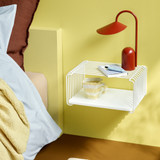
Panton Wire Single Inlay Shelf
Montana
Starting at $45.00


Danish Architect & Designer
The designer who taught a generation not to be afraid of color — and turned rooms into experiences.
Discover His Story
1926 – 1998
Verner Panton trained as an architect in Copenhagen and cut his teeth working under Arne Jacobsen — quietly rebelling against Danish modernism's restraint the whole time. In 1953 he set off across Europe in a converted Volkswagen van, pitching his ideas to manufacturers at every stop. By 1955, Fritz Hansen was producing his first chairs.
His defining design took over a decade to arrive. Panton spent years chasing a single-piece cantilever chair — a shape no one had successfully manufactured. Vitra finally brought it to life in 1967, molded from one continuous piece of plastic, and it's remained one of the most recognizable chairs of the twentieth century ever since.
Total Environments
Color-drenching, anyone? Decades before it had a name (or a hashtag), Panton was already doing it best. By the late 1960s he'd stopped designing objects one at a time. For the Spiegel publishing house in Hamburg, and Bayer's Visiona exhibitions in Cologne, he drenched entire rooms in a single saturated world — floor, wall, ceiling, and furniture melting into one. Call it interior design. He'd have called it total immersion.
"The main purpose of my work is to provoke people into using their imagination."
Verner Panton

Vitra, 1967
Panton's obsession with an unbroken, legless silhouette began years before the chair that would carry his name. His 1965 S-Chair for Thonet — the first cantilever chair molded from plywood — was an early attempt at the same idea in a different material. Vitra, his partner since 1963, spent years working out how to cast the shape from a single piece of plastic.
When the Panton Chair was finally unveiled in the Danish magazine Mobilia in 1967, it was unlike anything before it: one continuous sweep from headrest to foot, no legs, no joints. Panton received Denmark's PH Prize that same year. Vitra still produces the chair today, virtually unchanged.
Shop the Chair
&Tradition, 1968
The Flowerpot's two hemispheres, facing each other like a flower in permanent bloom, first appeared in 1968. The shape has since multiplied into nine different forms, from a handheld portable to a full floor lamp — the same idea, endlessly re-scaled.
Shop the CollectionMontana, 1971
Even his seating kept moving. Pantonova let a single sculptural module bend into a line, a curve, or a full circle — proof that Panton rarely saw a design as finished so much as a shape still deciding what it wanted to be.
Shop PantonovaLouis Poulsen, 1971
Louis Poulsen brought that same year's energy to lighting with Panthella, a trumpet-shaped form imitated so often since 1971 that most people who own a copy have never seen the original.

Montana, Reissued
Stack two or three units, mount a single one to the wall, or line a row of them up into an impromptu room divider. Panton Wire was built from heavy-gauge steel and designed from the start to multiply — the same module, endlessly recombined.
Shop Panton Wire
A Designer’s World
If you would like a hand bringing his work into your space, our design team is always happy to help.
Panton Wire Single Inlay Shelf
Montana
Loading results...